
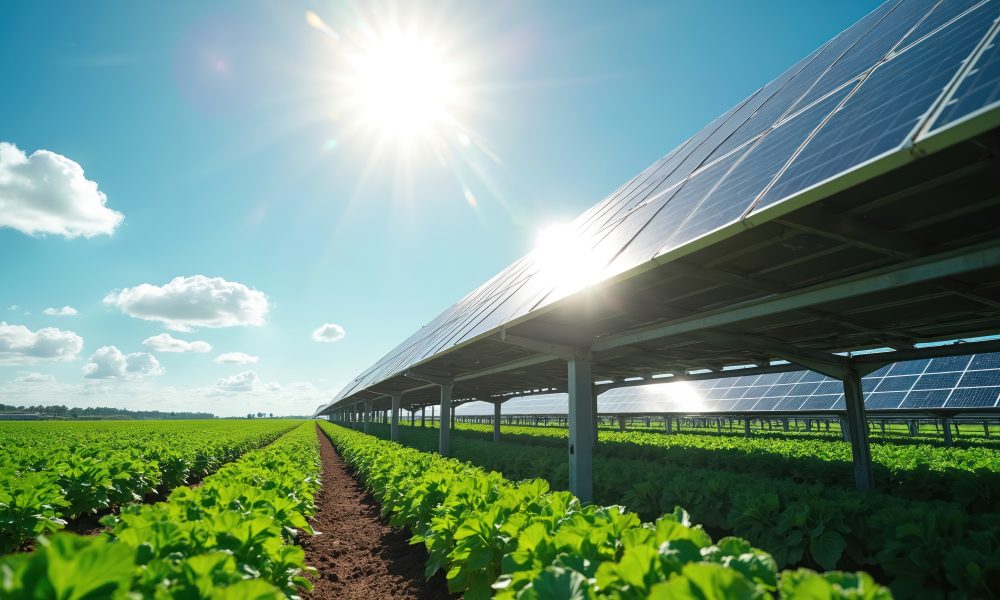
At the farming-system scale, AV diversifies income streams and stabilizes yields under climatic variability, whereas at the landscape scale, it fosters multifunctionality by supporting regenerative resource flows and ecological resilience.
Abstract
Agrivoltaics (AV) has emerged as an integrated land-use innovation capable of simultaneously addressing food, energy, and water challenges, yet its systemic implications for farming system sustainability remain insufficiently synthesized.
This review adopts a farming system dynamics perspective to examine how AV systems reorganize biophysical, ecological, and socio-economic interactions across agroecosystems. Drawing upon agroecological principles, pathways of sustainable intensification and ecological intensification, and resource-loop strategies in circular economy, we identify the key elements and cause-and-effect relationships that shape AV system performance.
Evidence indicates that the co-location of photovoltaics (PV) structures and crop cultivation generates new system properties, altered light distribution, moderated microclimates, redistributed soil moisture, and diversified production functions that influence productivity, resource-use efficiency, ecological services, and farm resilience.
Using causal loop analysis, we conceptualize four central feedback dynamics:
(i) PV–crop trade-offs and spatial-sharing relationships;
(ii) microclimate modifications and crop physiological responses;
(iii) ecological performance and landscape-level interactions; and
(iv) circularity loops connecting resource conservation, renewable-energy substitution, soil processes, and material flows.
This feedback collectively determines eco-efficiency outcomes, including enhanced land-equivalent productivity, improved water-use efficiency, strengthened regulating services, and reductions in external energy dependence.
At the farming-system scale, AV diversifies income streams and stabilizes yields under climatic variability, whereas at the landscape scale, it fosters multifunctionality by supporting regenerative resource flows and ecological resilience.
Building on these insights, we propose an integrated framework that links agroecological elements with dynamic feedback structures to guide context-specific AV design, management, and governance. This system-oriented synthesis provides a foundation for future research and policy efforts aimed at optimizing AV as a circular, resilient, and sustainable farming system innovation.